Our solution for
carbon credit buyers
Creating carbon sinks you can touch and visit.
Carbon removal only works when carbon is securely stored. That’s why we provide credits you can trust - built on high durability, traceability, and minimal risk of reversal. These are the hallmarks of high-quality carbon removal.
Every cubic meter of concrete with ecoLocked permanently stores carbon. We transform buildings into carbon sinks that you can touch and visit.
.svg)
Durable
The carbon sequestered in concrete remains permanently stored. It becomes mineralized within the cement matrix, ensuring exceptional stability and minimal risk of leakage, even after dismantling and recycling.

Scalable
ecoLocked Materials can be used in up to 90% of concrete applications, enabling the potential storage of 2,000,000,000 tonnes of CO₂ per year.

Traceable
Based on a controlled manufacturing process, we ensure precise verification, tracking, and documentation of the carbon stored in every batch of concrete. Monitoring over time is possible through sampling.
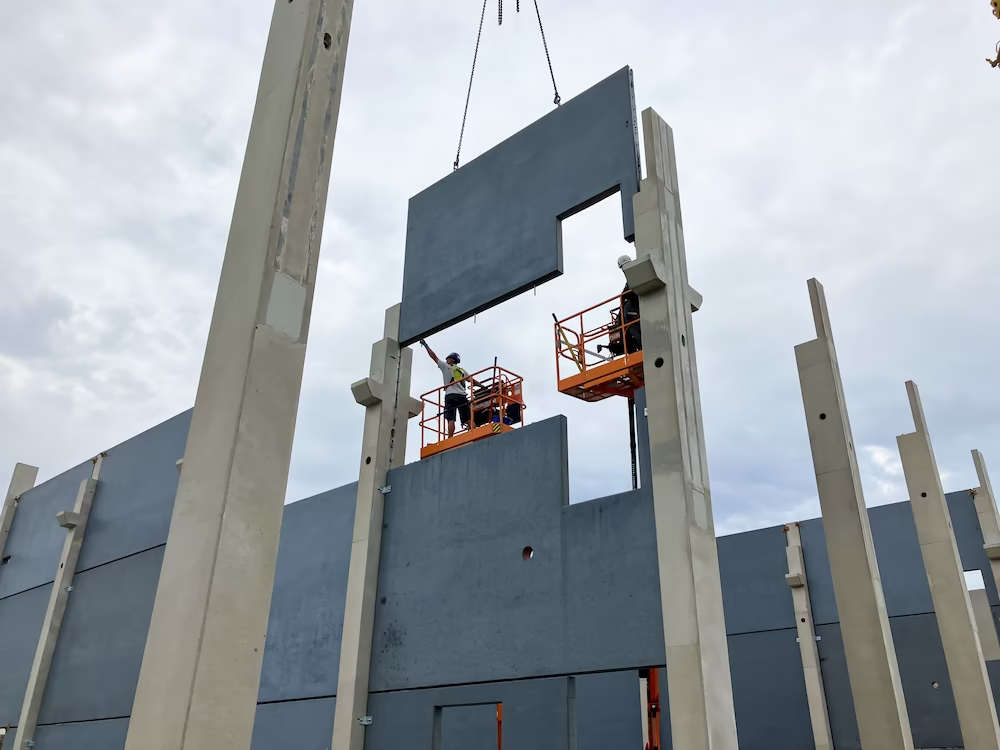
One building today.
A carbon-storing city tomorrow.
Proven
130 t CO₂ stored in concrete
or 30 laps around the Earth in an SUV
Now Scaling
250,000 t CO₂ by 2030
or 1.400 laps around the Earth in an SUV
Co-Benefits: Nature, climate & community
ecoLocked carbon storage creates cascading benefits across the value chain — from waste valorization to healthier urban ecosystems.

Circularity & Community


Biodiversity

CO₂ Avoidance / Reduction
Generate carbon credits from your own real estate assets
With ecoLocked, you can create negative emissions in your own construction projects by integrating our CO₂-negative concrete additives.
Choose how to account for the carbon removal:
Insetting: Treat the carbon removal as an internal emissions reduction, to compensate for emissions in in your company and/or on construction product level.
A carbon credit is issued and then immediately retired on behalf of your company.Carbon markets: Alternatively, you obtain your own third-party verified carbon removal credits to trade on the voluntary carbon market.
Regardless of your strategy, ecoLocked provides full MRV support to ensure traceability and third-party validation.
Ideal for:
- Corporate real estate (e.g. offices, data centers, supermarkets, warehouses, …)
- Real estate developers & construction Firms
- Green real estate investors & infrastructure funds
FAQs
How can I use the carbon removal certificates in my sustainability reporting?
Insetting - directly reducing your own footprint:
When you use ecoLocked Materials in your own buildings or construction projects, the CO₂ stored within is directly accounted for within your corporate footprint. This CO₂ removal occurs within your value chain, thereby reducing your reported footprint accordingly.
Under the CSRD/ESRS and SBTi standards, this is considered part of your own reduction efforts.
- CSRD / ESRS: Reported as removals from own operations and the value chain. Disclose storage medium & permanence
- SBTi: Qualifies as Direct removal if the removal occurs on your own assets
Offsetting - compensating emissions elsewhere:
When you purchase CO₂ credits from ecoLocked without using the materials yourself, the CO₂ removal is accounted for outside your value chain. Your reported corporate footprint remains unchanged, and the compensation is reported separately.
Under CSRD/ESRS, this is reported as emissions removals outside your value chain. Under SBTi, this is considered a measure to compensate for residual emissions.
- CSRD / ESRS: Reported separately as GHG removals outside the value chain. Disclose storage medium & permanence
- SBTi: Recognized as Beyond Value Chain Mitigation (BVCM) to compensate for remaining emissions
How long will the carbon remain stored? Are there risks of it being released back into the atmosphere?
The carbon is converted into a highly stable solid form and chemically integrated into concrete and similar mineral-based materials. Once embedded, the carbon becomes part of the material’s microstructure and remains immobilized for hundreds to thousands of years. The risk of re-release is extremely low because the carbon is not stored biologically or in a reactive form. Even if the concrete is demolished or recycled, the carbon remains in a solid, mineral-bound state rather than reverting to CO₂.
What are the co-benefits beyond CO₂ storage?
Our approach delivers environmental and community benefits in addition to durable carbon removal. Using biomass residues for biochar supports waste valorization, reduces landfill needs, and creates economic opportunities for rural communities involved in local sourcing and processing. Replacing a portion of sand and aggregates lowers quarrying pressure and supports healthier ecosystems through sustainable biomass use.
How do you verify and certify the carbon removal?
We use a rigorous MRV framework that measures the carbon stabilized in our material, tracks it through the full value chain and validates each step with independent third-party auditors. Credits are then issued through established carbon removal standards so buyers can rely on transparent, high-integrity accounting.
Is this solution scalable and practical today?
Yes. Our process fits directly into existing biomass sourcing networks and concrete production, which is one of the world’s largest industrial ecosystems. Because concrete is produced at large global volumes, it represents a uniquely scalable carbon sink.
Can I use it toward my company’s climate targets?
Yes. Our credits are categorized as durable carbon removal and can be applied to neutralize residual emissions within corporate net-zero pathways. They align with the expectations of leading frameworks such as SBTi and are accepted within voluntary markets focused on high-quality removals.
Measurement, Reporting and Verification
Our MRV partners validate each batch of carbon stored in concrete through transparent and forgery-proof digital systems.


Interested in a long-term offtake, contact us:

.svg)
.svg)


.svg.png)